
.png?width=750&height=750&name=Thought%20Leadership%20(3).png)


.png?width=750&height=750&name=Webinar%20Linkedin%201x1%20(3).png)
.png?width=1200&height=1200&name=Webinar%20Linkedin%201x1%20(6).png)

.png?width=750&height=750&name=Webinar%20Linkedin%201x1%20(11).png)
.png?width=2000&name=3x2%20Images%20(4).png)

.png?width=1200&height=1200&name=Webinar%20Linkedin%201x1%20(10).png)

Procurement analytics is the practice of collecting, structuring, and analyzing procurement data – spend, supplier performance, risk, quality, and ESG – to make better sourcing and supplier decisions. In plain terms: it turns the data your procurement team already sits on into answers. Which suppliers are actually performing? Where is money leaking? What risk is about to bite you? That's procurement analytics.
We first called analytics “procurement's new best friend” back when CPO surveys were just starting to rank it as the technology to watch. Fast forward to 2026, and the friendship has gotten serious. Analytics is no longer the promising new acquaintance – it's the friend who helps you move apartments, tells you when you have spinach in your teeth, and occasionally saves your quarter.
Why procurement analytics matters more and more
Three things have changed since procurement first swiped right on analytics:
1. AI eats data for breakfast. Every procurement team is being told to “use AI” today – AI agents for intake, AI for risk predictions, AI for supplier scoring. Here's the uncomfortable truth: AI is only as good as the data underneath it. Procurement analytics is the foundation. Without clean, structured, connected data, your AI agent is just a very confident intern.
2. Regulation stopped being optional. CSRD reporting, CSDDD due diligence obligations, supply chain transparency laws – regulators now expect you to prove what's happening in your supply base, not just describe it. That proof is analytics: auditable data on supplier ESG performance, risk exposure, and corrective actions.
3. Volatility became the baseline. Tariff swings, geopolitical shocks, supplier insolvencies – the teams that navigate disruption best are the ones that see it coming in their data. Reactive firefighting is expensive. Analytics is how you move to proactive.
The four types of procurement analytics
Strip away the consultant vocabulary and procurement analytics comes in four flavors, each answering a different question:
|
Type |
Question it answers |
Procurement example |
|
Descriptive |
What happened? |
Spend per category and supplier last quarter; on-time delivery rates per site. |
|
Diagnostic |
Why did it happen? |
Quality issues traced to a specific supplier facility after a process change. |
|
Predictive |
What will happen? |
Early-warning signals on supplier financial distress or capacity constraints. |
|
Prescriptive |
What should we do? |
AI-recommended actions: re-source, dual-source, or launch a supplier improvement project. |
Most teams live in descriptive land. The value curve bends sharply upward as you move right in that table – and today, predictive and prescriptive are no longer enterprise-only luxuries. Modern SRM platforms ship with them out of the box.
What can you actually use procurement analytics for?
Supplier performance management
Scorecards, KPIs, and trend lines that show which suppliers deliver and which ones drain your team. If you're unsure what to measure, start with our guide to the top 15 supplier performance management KPIs.
Risk monitoring
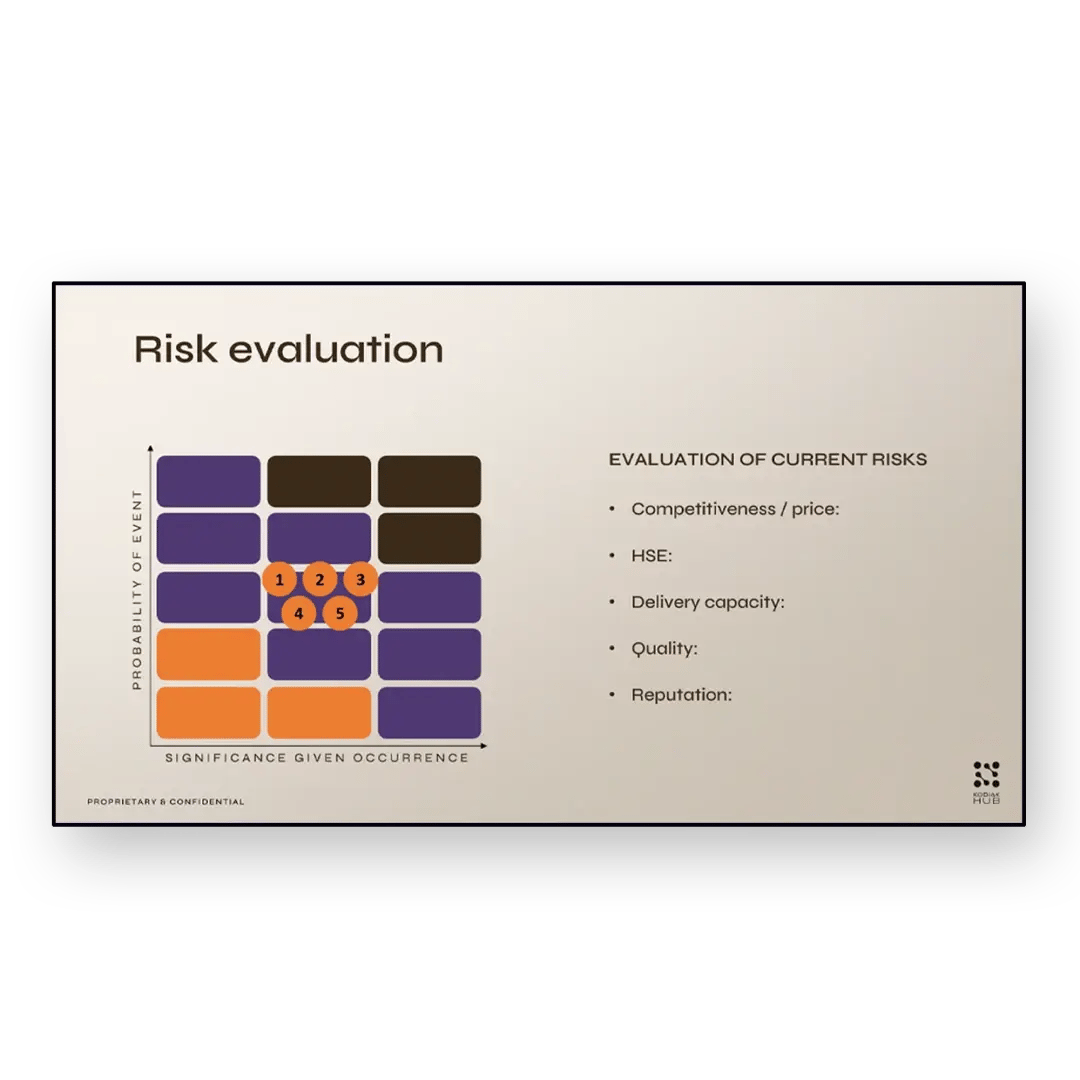
Combining internal data (quality incidents, delivery deviations) with external signals (financial ratings, sanctions, media coverage) gives you a live risk picture instead of an annual assessment. More on that in our guide to supplier risk management.
Spend and category insight
Where the money goes, where it leaks (maverick spend, duplicate suppliers, tail spend), and where consolidation pays off.
ESG and compliance reporting
Analytics turns supplier ESG data from a yearly questionnaire ordeal into a continuously updated, audit-ready view – exactly what CSRD and CSDDD ask for.
Supplier collaboration and innovation
Shared data creates shared truth. When you and your supplier look at the same scorecard, conversations shift from blame to improvement. (We've written about why that matters in supplier collaboration.)
The unglamorous truth: data quality still decides everything
This was true when we first wrote this article, and it's even truer now that AI sits on top of everything: analytics is only as reliable as the data feeding it. Back in 2018, nearly half of CPOs pointed to data quality as the main barrier to applying new technology in procurement. The tooling has improved massively since – the homework hasn't gone away.
Before your analytics can start skipping down the sidewalk with you, hand in hand, you need three boring-but-critical things:
One home for supplier data. Spreadsheets scattered across inboxes are where insights go to die. Consolidate supplier information, documents, certificates, and assessments into a single source of truth – ideally during supplier onboarding, so data is born clean instead of cleaned later.
Connected systems. Your ERP, S2P suite, and best-of-breed tools each hold a piece of the puzzle. Integrations are what turn five partial views into one complete one.
Data hygiene as a habit. Ownership, update routines, and validation rules. Not glamorous. Absolutely decisive.
How to get started with procurement analytics (without a two-year project)
-
Step 1: Pick one decision, not one dashboard. Start from a question that matters – “which of our strategic suppliers are underperforming?” – and work backwards to the data you need. Dashboards built without a decision in mind become wallpaper.
-
Step 2: Gather and structure the data for that decision. Usually supplier master data, performance data, and spend. Get it into one place, in one format.
-
Step 3: Visualize and share. A scorecard your category managers actually open beats a data lake nobody swims in. Visualized, accessible data is what changes behavior.
-
Step 4: Add prediction and action. Once descriptive analytics runs smoothly, layer on risk predictions and AI-recommended actions – and connect insights to workflows (improvement projects, corrective actions) so analysis turns into outcomes. This is exactly what supplier performance management software is built for.
So, that’s analytics… Still your best friend in 2026.
FAQ: Procurement analytics
What is procurement analytics?
Procurement analytics is the process of collecting and analyzing procurement-related data – such as spend, supplier performance, risk, quality, and ESG data – to support better sourcing and supplier management decisions.
What's the difference between procurement analytics and spend analysis?
Spend analysis is one slice of procurement analytics, focused on what you buy, from whom, and at what cost. Procurement analytics is the whole cake: spend plus supplier performance, risk, quality, compliance, and ESG.
How is AI changing procurement analytics?
AI shifts analytics from descriptive to predictive and prescriptive: instead of reporting what happened, modern platforms predict supplier risk, flag anomalies, and recommend actions automatically. The prerequisite is clean, connected supplier data – AI cannot fix a broken data foundation, only amplify a solid one.
What KPIs should procurement analytics track?
It depends on your goals, but common ones include cost savings and avoidance, on-time delivery, quality (defect/PPM rates), supplier risk scores, contract compliance, and ESG performance. See our full KPI guide for definitions and benchmarks.
Do small procurement teams need analytics software?
Small teams arguably benefit most – analytics automates the reporting work that would otherwise eat a big share of a lean team's week. Modern SRM platforms are plug-and-play, so getting started takes weeks, not years.
Ready to turn your supplier data into your competitive edge? Explore Kodiak Hub's AI-powered SRM suite – analytics included, best friendship guaranteed.