
.png?width=750&height=750&name=Thought%20Leadership%20(3).png)


.png?width=750&height=750&name=Webinar%20Linkedin%201x1%20(3).png)

.png?width=1200&height=1200&name=Webinar%20Linkedin%201x1%20(6).png)

.png?width=750&height=750&name=Webinar%20Linkedin%201x1%20(11).png)
.png?width=2000&name=3x2%20Images%20(4).png)

.png?width=1200&height=1200&name=Webinar%20Linkedin%201x1%20(10).png)

Supplier data is everywhere - and that is exactly the problem.
For many procurement teams, critical supplier information still lives across ERPs, P2P systems, inboxes, shared drives, spreadsheets, onboarding forms, and local business units. The result is supplier data chaos: duplicate records, expired certificates, incomplete risk profiles, outdated contact details, and no reliable way to know which version of supplier information is actually true.
In 2026, that is no longer just an operational inconvenience. It is a resilience problem.
Procurement teams are being asked to manage more supplier risk, more compliance requirements, more ESG expectations, and more business volatility than ever before. Deloitte’s 2025 Global CPO Survey found that 64% of respondents prioritized greater supply chain visibility as a key risk mitigation strategy, while 61% focused on improving supplier information sharing and collaboration. (Deloitte) McKinsey also highlights that many procurement leaders still struggle with poor-quality data and difficulty integrating data from multiple sources into a reliable category view. (McKinsey)
That is where supplier information management software comes in.
The right SIM platform gives procurement, master data, risk, sustainability, and category teams a single place to collect, validate, maintain, and act on supplier data. It becomes the digital foundation for better onboarding, better compliance, better supplier collaboration, and better decisions.
In this guide, we compare the best supplier information management software for 2026, including what to look for, how the top platforms differ, and why Kodiak Hub stands out as the collaborative SIM and supplier performance hub for modern procurement teams.
What is Supplier Information Management Software?
Supplier information management software is a centralized platform used to collect, store, validate, update, and manage all information related to a company’s suppliers.
That can include basic supplier master data, such as:
- Company name
- Legal entity details
- Tax and VAT information
- Bank account details
- Contact information
- Locations and production sites
- Product or service categories
But modern SIM platforms go much further. They also help teams manage strategic supplier information, such as:
- ESG certifications
- Quality certificates
- Insurance documents
- Financial health data
- Risk indicators
- Compliance documentation
- Ownership information
- Diversity status
- Sustainability performance
- Supplier segmentation data
In other words, a SIM platform is not just a database. It is the operating layer that keeps supplier information accurate, usable, and connected across the business.
Learn more about this in supplier information management: how to get it right
The single source of truth for supplier data
Without online supplier information management software, supplier data often becomes fragmented. Finance may have one version of a supplier record. Procurement may have another. Quality, sustainability, and legal may each maintain their own files.
That creates obvious problems:
- Duplicate supplier records
- Delayed onboarding
- Manual rework
- Expired documents
- Inconsistent compliance checks
- Limited supplier visibility
- Poor reporting
- Risk blind spots
A strong SIM platform solves this by integrating with systems such as SAP, Oracle, Microsoft Dynamics, and P2P platforms. Instead of every team maintaining its own supplier data, SIM becomes the single source of truth that pushes clean, validated information into the systems that need it. Learn more about centralizing your supplier data.
SIM vs. SRM: what is the difference?
Supplier Information Management, or SIM, is about the data.
Supplier Relationship Management, or SRM, is about the relationship.
Think of SIM as the foundation. It answers questions like:
- Who are our suppliers?
- What do we know about them?
- Is their data complete?
- Are their certificates valid?
- Are they approved to work with us?
- Which systems have the correct supplier master data?
SRM builds on that foundation. It answers questions like:
- How is this supplier performing?
- Are they improving?
- Are they helping us reduce risk?
- Are they supporting our innovation or sustainability goals?
- What actions should we take next?
The best SIM platforms increasingly connect both worlds. They do not just store supplier information. They turn that information into workflows, insights, scorecards, and supplier improvement actions.

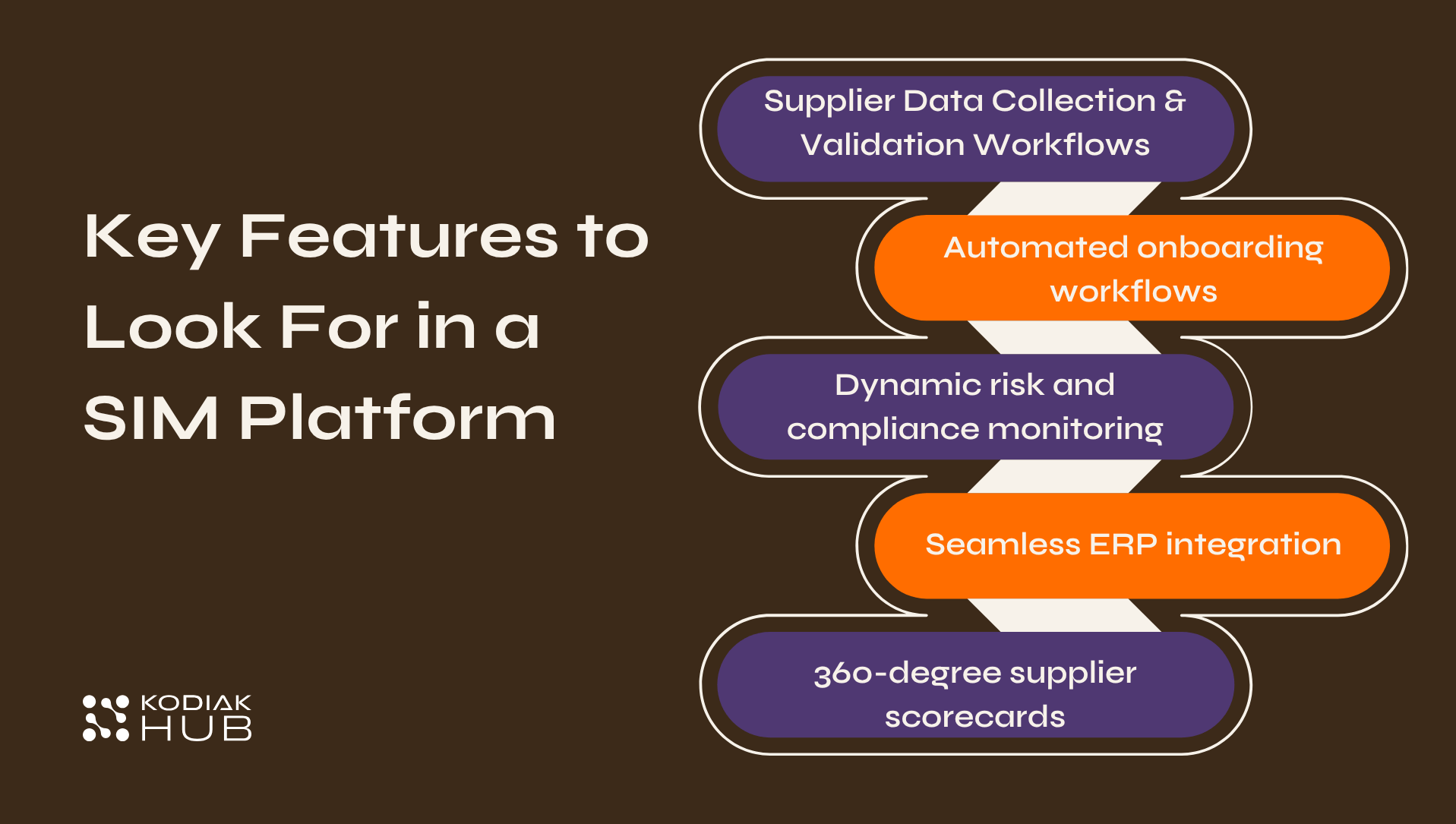
Key Features to Look For in a SIM Platform
Choosing a SIM platform is not just about finding somewhere to store supplier records. The real value comes from how well the software helps you collect, clean, govern, connect, and use supplier data.
Here are the most important features to look for.
Supplier Data Collection & Validation Workflows
Supplier information management starts with collecting the right data in a structured way. A strong SIM platform should help procurement teams standardize how supplier information is requested, reviewed, validated, and maintained across the organization.
Instead of relying on scattered spreadsheets, email threads, or one-off document requests, teams should be able to create clear workflows for different supplier categories, regions, risk levels, and business requirements. This helps ensure that supplier records are complete, consistent, and ready to use across procurement, risk, sustainability, quality, and finance.
Look for capabilities such as:
- Configurable supplier data fields
- Structured onboarding questionnaires
- Internal review and approval workflows
- Document and certificate collection
- Data completeness tracking
- Role-based ownership of supplier information
- Clear audit trails for updates and approvals
This gives procurement teams more control over supplier data quality, while reducing manual follow-up and improving consistency across the supplier base. Learn more about vendor information management software.
Automated onboarding workflows
Supplier onboarding is one of the most important SIM use cases.
A good SIM platform should help teams move from “request to approve” without relying on email chains and manual spreadsheets. That means configurable workflows for different supplier types, categories, countries, and risk levels.
For example, a low-risk indirect supplier may only need basic company data and payment details. A strategic direct materials supplier may need quality certificates, ESG documentation, production site data, financial checks, and multiple internal approvals.
The platform should support both journeys without forcing every supplier through the same rigid process.
Dynamic risk and compliance monitoring
Supplier information is not static. A certificate can expire. A supplier’s financial health can change. A new regulation can create new documentation requirements. An ESG assessment can become outdated.
That is why dynamic monitoring matters.
Look for features such as:
- Certificate expiry alerts
- Compliance document tracking
- ESG and sustainability data capture
- Financial health indicators
- Risk alerts
- Audit trails
- Approval histories
- Automated reminders
This is especially important as procurement becomes more responsible for managing resilience, sustainability, and third-party risk. Gartner’s 2025 procurement research notes that procurement leaders are dealing with rapid change across data and analytics, AI, staffing models, and supplier risk management. (Gartner)
Seamless ERP integration
SIM software should not sit in isolation.
The platform should integrate with core enterprise systems such as:
- SAP
- Oracle
- Microsoft Dynamics
- Workday
- Coupa
- IFS
- Other ERP, P2P, and source-to-pay tools
The goal is to push and pull clean supplier data between systems, while still maintaining one governed supplier record.
This is where supplier master data management becomes essential. If your SIM platform cannot support clean supplier master data, your ERP will keep receiving incomplete, duplicated, or inconsistent records.
360-degree supplier scorecards
A modern SIM platform should give teams a 360-degree view of the supplier.
That means bringing together:
- Supplier profile data
- Onboarding status
- Certificates
- Risk information
- ESG data
- Performance metrics
- Category ownership
- Business criticality
- Improvement actions
- Collaboration history
This turns supplier information from static master data into a living supplier intelligence layer. See Kodiak Hub's 360 supplier scorecard software.
The Best Supplier Information Management Software Providers in 2026
The supplier information management software market includes specialist SIM platforms, enterprise data governance tools, and broader source-to-pay suites.
Here are five of the best supplier information management software providers to consider in 2026.
1. Kodiak Hub: The Collaborative SIM & Performance Hub
Kodiak Hub is built for procurement teams that want supplier information to become more than clean data. It helps teams turn supplier data into better collaboration, better performance, and better decisions.
Where many SIM platforms focus mainly on storage and governance, Kodiak Hub connects supplier information with performance, ESG, risk, compliance, and supplier development. That makes it a strong fit for organizations that want a 360-degree supplier view and a practical way to act on supplier insights.
Key SIM features
Smart onboarding
Kodiak Hub supports customizable onboarding journeys for different supplier categories, regions, and risk profiles. That means teams can collect the right information from the right suppliers without creating unnecessary friction.
Automated certificate management
Procurement teams should not have to manually chase expired ISO certificates, ESG documentation, or compliance files. Kodiak Hub helps teams track supplier certificates, monitor expiry dates, and keep documentation up to date.
360-degree supplier views
Kodiak Hub combines supplier information with ESG, risk, compliance, and performance data in one intuitive dashboard. Instead of switching between systems, teams can see the full supplier picture in one place.
Supplier collaboration workflows
Kodiak Hub is designed to help teams use supplier data, not just store it. Supplier insights can trigger smart actions, improvement projects, follow-ups, and collaboration workflows.
Performance and risk context
Supplier data becomes more useful when it is connected to how suppliers actually perform. Kodiak Hub helps teams view supplier information alongside scorecards, KPIs, sustainability data, and risk indicators.
Why Kodiak Hub stands out
Kodiak Hub stands out because it treats supplier information management as the foundation for supplier value creation.
The platform is not only about collecting supplier records. It is about helping procurement teams understand suppliers, collaborate with them, and improve outcomes over time.
That makes Kodiak Hub especially valuable for organizations that want to move beyond reactive supplier administration and build a more strategic, data-driven supplier management function. Great use-cases in manufacturing, food & beverage, energy & infrastructure, , services, retail & wholesale, process industries like pharmaceuticals, advanced materials, chemicals etc.
Best for
Kodiak Hub is best for mid-to-large enterprises that want to turn supplier data into a competitive advantage, especially teams focused on supplier performance, ESG, risk, compliance, and supplier collaboration.

2. Ivalua: The Flexible Source-to-Pay Platform
Ivalua is a broad source-to-pay platform with supplier management capabilities across supplier information, risk, performance, sourcing, contracts, procurement, and payments. Its supplier management solution is positioned around giving teams a 360-degree view of supplier information and activities across the source-to-pay process.
For organizations that want SIM to sit inside a wider procurement transformation program, Ivalua can be a strong option. It connects supplier information with spend, sourcing, contracts, risk, and performance, which can help larger procurement teams manage supplier data in the context of broader procurement workflows.
Key strengths
Ivalua is strong in:
- Source-to-pay process coverage
- Supplier information and supplier relationship management
- Supplier risk and performance tracking
- Configurability for complex procurement organizations
- Connecting supplier data with sourcing, contracts, and spend
Potential limitations
Because Ivalua is a broad platform, teams looking specifically for an intuitive, best-of-breed SIM and supplier performance experience should carefully assess ease of use, implementation complexity, and how quickly procurement teams and suppliers can adopt the platform.
A flexible suite can be powerful, but it may also require more configuration and change management than a focused supplier management platform.
Best for
Ivalua is best for large enterprises that want supplier information management as part of a wider source-to-pay transformation, especially when procurement teams need flexibility across sourcing, contracts, spend, supplier risk, and supplier performance.
3. SAP Ariba: The Legacy Ecosystem
SAP Ariba is one of the best-known procurement platforms in the world. Its supplier management capabilities are often considered by companies that already operate deeply inside the SAP ecosystem.
For SAP-first organizations, the main appeal is ecosystem fit. Supplier information can connect into a broader SAP procurement and ERP environment, which can be valuable for organizations standardizing around SAP.
Key strengths
SAP Ariba is strong in:
- SAP ecosystem integration
- Large enterprise procurement processes
- Supplier network access
- Source-to-pay workflows
- Established enterprise adoption
Potential limitations
The trade-off is complexity. SAP Ariba can be powerful, but many teams experience it as difficult to configure and less intuitive for suppliers and end users. For SIM specifically, supplier experience matters. If suppliers find the portal hard to use, data quality suffers.
Read more: 9 SAP Ariba Alternatives for Supplier Management
Best for
SAP Ariba is best for companies already fully committed to SAP and looking for supplier management inside a broader SAP procurement architecture.
4. Jaggaer: The Comprehensive Suite
Jaggaer is a broad source-to-pay suite with supplier management capabilities. It has a strong presence in industries with complex direct materials, manufacturing, sourcing, and procurement needs.
For companies looking for a wider procurement suite rather than a dedicated best-of-breed SIM platform, Jaggaer can be a strong contender.
Key strengths
Jaggaer is strong in:
- Source-to-pay suite coverage
- Direct materials procurement
- Manufacturing use cases
- Supplier management
- Category and sourcing workflows
Potential limitations
Because Jaggaer covers a broad range of procurement processes, teams should assess whether its SIM capabilities are deep and intuitive enough for their specific supplier information management needs.
A suite can be valuable, but broader coverage does not always mean stronger supplier data usability.
Best for
Jaggaer is best for manufacturing and direct materials organizations that want a comprehensive procurement suite rather than a dedicated SIM and supplier performance platform.
5. Coupa: The Spend Management Leader
Coupa is widely known for spend management and procure-to-pay. Its supplier information management capabilities are often used by teams that want supplier data connected to spend visibility, financial controls, and procurement workflows.
Coupa can be a strong option for organizations prioritizing financial compliance and spend control.
Key strengths
Coupa is strong in:
- Spend management
- Procure-to-pay processes
- Supplier onboarding
- Financial compliance
- Spend visibility
Potential limitations
For teams that need deeper supplier performance management, ESG collaboration, risk action tracking, or supplier development workflows, Coupa may need to be complemented by more specialized supplier management capabilities.
Explore alternatives of Coupa: Best Coupa Alternatives for Supplier Management
Best for
Coupa is best for teams prioritizing spend control, financial cleanliness, and supplier information connected to P2P processes.
Comparison Table: Top SIM Software at a Glance
| SIM Software | Key Strength | Best For | Ease of Use | Integration Depth |
|---|---|---|---|---|
| Kodiak Hub | Collaborative SIM, supplier performance, quality, ESG, risk, and 360-degree supplier views | Mid-to-large enterprises that want to turn supplier data into supplier value - for manufacturing, food & beverage, energy & infrastructure, process industries like pharma and alike, services, retail & wholesale | High | Strong ERP and procurement system integration |
| Ivalua | Flexible source-to-pay platform with supplier information, risk, performance, sourcing, contracts, and spend management | Large enterprises that want SIM inside a broader procurement transformation program | Medium | Strong across source-to-pay and enterprise procurement workflows |
| SAP Ariba | SAP ecosystem fit and broad procurement coverage | SAP-first organizations | Medium to low | Very strong within SAP environments |
| Jaggaer | Broad source-to-pay suite with direct materials strength | Manufacturing and direct procurement teams | Medium | Strong suite-level integration |
| Coupa | Spend management and financial compliance | Teams focused on spend visibility and P2P control | Medium | Strong within Coupa spend management ecosystem |
How to Choose the Right SIM Software
The best supplier information management software is not always the biggest platform. It is the one that fits your supplier base, data complexity, operating model, and procurement maturity.
Here are three practical questions to ask before choosing a SIM platform.
1. How complex is your supplier data?
A company with 500 mostly local suppliers has very different SIM needs from a global manufacturer with 50,000 suppliers across regions, entities, categories, and production sites.
Start by mapping your supplier data complexity:
- How many active suppliers do you manage?
- How many ERPs or P2P systems contain supplier data?
- How many supplier records are duplicated?
- Which teams own supplier data today?
- Which supplier documents expire regularly?
- Which supplier categories require deeper compliance checks?
- How much supplier information is still managed in spreadsheets?
If your problem is mainly supplier master data chaos, prioritize governance, data validation, and ERP integration.
If your problem is supplier visibility, collaboration, and performance, prioritize 360-degree scorecards, supplier portals, and action workflows.
In many mature procurement organizations, the answer is both.
2. What will the supplier experience be like?
Supplier experience is one of the most overlooked SIM selection criteria.
A platform can look impressive internally, but if the supplier portal is difficult to use, your suppliers will not keep their information updated. That means your internal teams will return to chasing data manually.
A good supplier experience should be:
- Clear
- Fast
- Mobile-friendly
- Easy to navigate
- Relevant to the supplier type
- Not overloaded with unnecessary questions
- Transparent about what is required
The easier it is for suppliers to provide accurate information, the better your supplier data will be.
3. Do you need best-of-breed SIM or a broader suite?
There are two main approaches.
A broader procurement suite can make sense if your organization wants one platform for sourcing, contracts, supplier onboarding, P2P, and spend management.
A best-of-breed SIM and supplier management platform can make more sense if your priority is depth: better supplier visibility, better scorecards, better collaboration, better ESG and risk context, and more actionable supplier data.
The key question is this:
Do you want supplier information to simply support procurement transactions, or do you want it to drive supplier strategy?
If the goal is clean records and basic onboarding, a suite module may be enough. If the goal is to use supplier information to improve resilience, sustainability, performance, and collaboration, a platform like Kodiak Hub is a stronger fit.
Learn about the 5 Benefits of Using Supplier Information Management Software.
Ready to Clean Up Your Supplier Data?
Bad supplier data leads to bad decisions.
It slows onboarding. It hides risk. It creates duplicate work. It weakens compliance. It makes supplier collaboration harder. And when disruption hits, it leaves procurement teams without the visibility they need to act quickly.
Good supplier information management software changes that.
With the right SIM platform, supplier data becomes accurate, connected, and actionable. Procurement teams can onboard suppliers faster, reduce manual admin, monitor risk and compliance, and build a stronger foundation for supplier performance.
Kodiak Hub helps leading procurement teams manage supplier information, performance, ESG, risk, and collaboration in one intuitive platform.
See why leading procurement teams choose Kodiak Hub to manage their supplier information. Book a Demo Today 👇🏼