
.png?width=750&height=750&name=Thought%20Leadership%20(3).png)


.png?width=750&height=750&name=Webinar%20Linkedin%201x1%20(3).png)



.png?width=1200&height=1200&name=Webinar%20Linkedin%201x1%20(6).png)

.png?width=750&height=750&name=Webinar%20Linkedin%201x1%20(11).png)
.png?width=2000&name=3x2%20Images%20(4).png)

.png?width=1200&height=1200&name=Webinar%20Linkedin%201x1%20(10).png)

The fastest way to burn money in manufacturing or food and beverage is not always a big, dramatic recall. It is the slow bleed: scrap, rework, line stops, expedited freight, and warranty claims that quietly stack up into the Cost of Poor Quality (COPQ). COPQ is commonly defined as the costs associated with providing poor quality products or services, including failures and the effort required to fix them. (asq.org)
This is why learning how to do supplier quality audits matters. In complex supply chains, an audit is not just a compliance hurdle. Done well, it is a sustainability and profitability lever. Good quality means less waste and re-work, and fewer “surprise” costs that procurement and quality teams end up firefighting later.
In this guide, you will get a practical 5-step roadmap to run supplier quality audits that actually move the needle, plus a checklist of what to look for. We will also show how to shift audits from reactive policing to proactive partnership using Supplier Relationship Management as the operating system behind the work. Start here if you want the fundamentals of Supplier Quality Management.
What is a Supplier Quality Audit?
A supplier quality audit is a systematic, evidence-based evaluation of a supplier’s quality management system and shop-floor execution against defined requirements (for example ISO 9001, IATF 16949, food safety standards, and your own specifications). The goal is to validate that the supplier can consistently produce conforming output at the required volume, not just pass a one-time inspection.
The Kodiak angle: an audit is one data point in a 360-degree supplier view
A supplier audit should not live as a lonely PDF in a folder called “Audit Reports - Final - Use This One.” It is one signal that should flow into the supplier’s scorecard, risk view, and relationship plan. When audit results are siloed, you lose the ability to spot patterns, compare suppliers, and prioritize improvement work.
Strategic value: lower TCO and enable collaborative innovation
Strong audit programs reduce Total Cost of Ownership by catching process risks before they become defects, scrap, or expediting. They also enable collaborative innovation: when a supplier’s process capability is understood and stable, you can co-develop improvements instead of constantly managing exceptions.
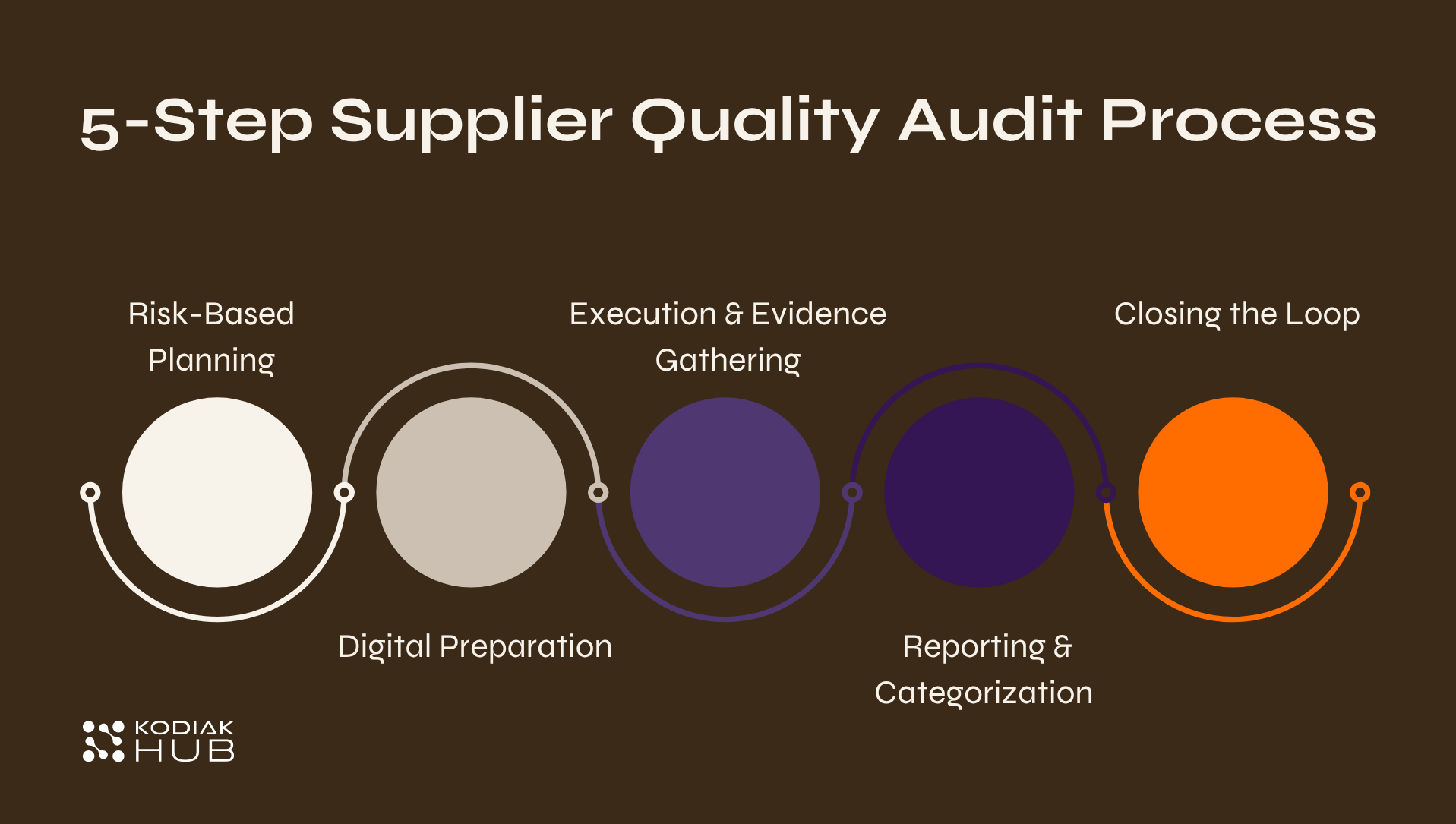
The 5-Step Supplier Quality Audit Process
This is the core “how to do supplier quality audits” roadmap. It is written for SQEs, quality managers, and procurement teams who need a repeatable method.
1. Risk-Based Planning: Don’t audit everyone equally
Auditing every supplier with the same depth is a fast way to waste travel budgets and burn out your team.
Instead, prioritize based on risk and impact:
- Criticality to production (single-sourced? long lead times?)
- Historical performance trends (OTIF, PPM/defects, NCR volume)
- Regulatory exposure (food safety, traceability requirements)
- Change activity (new processes, new sites, ownership changes)
- Business importance (new product introduction, strategic programs)
A simple rule: if a supplier is high impact or showing negative trends, increase audit frequency and depth. If a supplier is stable and low risk, move to lighter-touch surveillance.
2. Digital Preparation: do the homework before you arrive
The fastest audits are the ones where you already know what you are walking into.
Before the site visit, review documentation in a central portal:
- Certifications (ISO 9001, IATF, food safety, etc.)
- PPAP or equivalent approval packs (where applicable)
- Process FMEA and control plans
- Calibration and maintenance records
- Past audit reports and open findings
- Complaint history and CAPA effectiveness
The goal is to show up with a hypothesis: “Here are the 3 areas most likely to create defects or downtime.” This turns the audit from a tour into a targeted investigation.
3. Execution and Evidence Gathering: focus on the shop floor
The shop floor is where the truth lives.
A strong on-site audit includes:
- Walking the process end-to-end (from receiving to shipping)
- Observing work instructions vs. actual work
- Checking control points (inspection, SPC, mistake-proofing)
- Verifying training and competency where it matters
- Sampling records for traceability and change control
- Talking to operators, not only management
Capture evidence as you go. Photos and short videos can be incredibly useful for explaining issues internally and aligning with suppliers on what “good” looks like. The point is not to build a dossier. It is to remove ambiguity.
4. Reporting and Categorization: move beyond “major/minor”
Traditional “major/minor” labels are useful, but they are not enough to drive action.
Aim to categorize findings in a way that creates immediate clarity:
- Systemic vs. isolated (is this a one-off or a pattern?)
- Process control gap vs. documentation gap vs. capability gap
- Risk to customer (safety, compliance, performance, brand)
- Recurrence risk (how likely is this to come back?)
Write findings so they are actionable:
- What requirement was not met?
- What evidence shows that?
- What is the risk if unchanged?
- What is the expected correction and prevention path?
5. Closing the Loop: the most critical step (CAPA)
An audit without follow-up is basically a site visit with paperwork.
This is where CAPA comes in: Corrective and Preventive Actions. The goal is not just to fix the symptom, but to remove root cause and verify effectiveness.
A tight CAPA loop includes:
- One CAPA per finding (clean scope)
- Named owners (supplier and internal)
- Due dates aligned to risk (not “sometime next quarter”)
- Evidence requirements for closure
- Verification step (do not accept “we fixed it” without proof)
- Trend monitoring after closure
Poor follow-up is why many organizations experience repeat audit findings and “open recommendations” that carry forward year after year. (isaca.org)
Want a real-world example of closing the loop? See how Elfa increased supplier quality by 20% by moving audits and actions into a structured supplier development approach.
Essential Areas for Your Audit Checklist
Here are high-impact checklist areas tailored to manufacturing and food and beverage, but applicable across complex industries.
Management and culture
- Is quality visibly prioritized by leadership?
- Are KPIs reviewed, and are decisions made based on them?
- Does the supplier reward prevention, or only firefighting?
Process control
- Are Lean or Six Sigma methods applied where relevant (SPC, capability studies, error-proofing)?
- Are control plans actually used on the line?
- Are critical-to-quality parameters monitored and reacted to consistently?
Traceability
- Can the supplier trace a defect back to raw material, batch, shift, and machine settings?
- Are lot and batch records complete and retrievable?
Traceability is especially critical in food, pharma, and regulated environments.
Sustainability and waste
- Are scrap rates measured and trended?
- Is rework tracked as a signal, not hidden as “normal”?
- Is energy use monitored in a way that can support continuous improvement?
A quality program that reduces scrap and rework also reduces environmental footprint. That is why audits can be both a compliance tool and a sustainability lever. COPQ often includes rework, scrap, and failures that directly translate to waste. (asq.org)

Why Manual Audits are Failing Modern Supply Chains
Even strong auditors struggle when the system around them is manual.
The dark data problem
Audit reports trapped in PDFs and folder structures are “dark data.” They exist, but you cannot analyze them, trend them, or connect them to performance.
When audit evidence lives across spreadsheets, email, and shared drives, you also inherit spreadsheet risk: version chaos, weak controls, and poor auditability. Deloitte has highlighted how spreadsheet-dependent processes can expose organizations to unmitigated risks without strong lifecycle controls and ongoing assurance. (Deloitte)
The follow-up gap
The most common failure mode is not finding problems. It is closing them.
In manual setups, findings become email threads. Owners are unclear. Evidence is scattered. Follow-up becomes reactive. This is exactly how repeat findings persist over time. (ecampusontario)
Audit fatigue
Suppliers get asked the same questions by procurement, quality, ESG, and compliance in parallel. Without a shared system, everyone recreates the wheel, and suppliers disengage.
Modernizing the Audit with Kodiak Hub
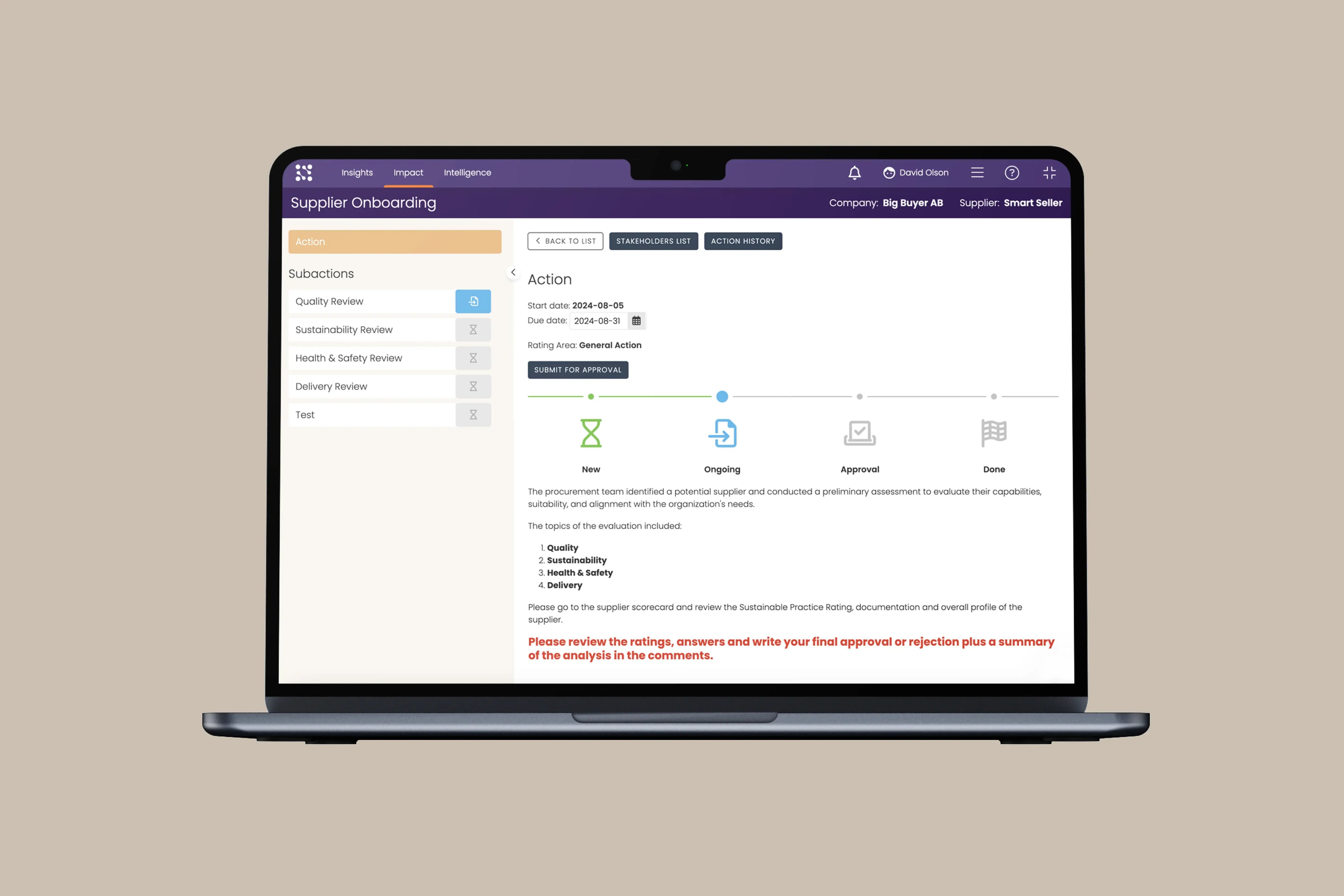
Kodiak Hub modernizes supplier quality audits by turning them into a structured workflow that connects planning, execution, evidence, CAPA, and supplier scorecards.
Mobile auditing app
Conduct audits on-site using a mobile auditing app that supports checklists, evidence uploads, and progress tracking. Offline capability matters when you are in a factory with weak connectivity, and syncing instantly after helps keep stakeholders aligned.
Smart Actions and CAPA automation
Instead of chasing actions in email, Smart Actions can automatically assign follow-ups, send reminders, and track progress against due dates. This is the difference between “we did an audit” and “we improved the supplier.”
360-degree visibility
Audit results should update the supplier’s scorecard automatically, so quality, procurement, and operations are looking at the same truth. This is how audits become a living signal, not a static report.
Templates aligned to industry standards
Use pre-built templates and configurable checklist builders aligned to common standards like ISO, IATF, and food safety approaches, then adapt them to your category needs.
Check this out If you want to see how Kodiak Hub fits Supplier Quality in the broader SRM workflow.
Frequently Asked Questions (FAQs)
How do you conduct a supplier quality audit?
Use a 5-step process: risk-based planning, digital preparation, shop-floor execution with evidence gathering, clear reporting, and a CAPA-driven follow-up loop that verifies closure.
What is a supplier quality audit checklist?
A supplier quality audit checklist is a standardized set of criteria used to evaluate a supplier’s quality system and process controls. It ensures audits are consistent across sites and auditors, and it makes findings comparable over time.
How often should you audit a supplier?
Use a risk-based approach. High-risk or high-impact suppliers may need audits quarterly or biannually. Stable, low-risk suppliers can be audited less frequently, with lighter surveillance in between.
What is the difference between an audit and an inspection?
An audit evaluates the process and management system (how quality is produced). An inspection evaluates product output (what quality looks like in a batch or unit). You need both, but audits are what prevent defects from recurring.
How do you audit supplier capacity?
Focus on throughput constraints and resilience: capacity vs. demand, OEE or downtime patterns, staffing flexibility, maintenance discipline, bottleneck processes, and contingency plans for surge volume or disruptions.
Ready to Move from Reactive to Proactive?
Progress precedes perfection. The goal is not to run perfect audits. The goal is to build a system where every audit creates measurable improvement: fewer defects, less waste, and more reliable supply.
If you want to move from reactive policing to proactive partnership, start by digitalizing the audit workflow and closing the CAPA loop with real ownership and visibility.
Book a Demo of Kodiak Hub’s Auditing Solution 👇🏼