

















Spend management is the process of gaining visibility into, controlling, and optimizing everything an organization buys across suppliers, categories, and departments. It brings together spend data, procurement policies, sourcing, contracts, and supplier management to help organizations make better purchasing decisions.
But visibility alone is not enough. You cannot manage spend effectively if you cannot connect it to the supplier receiving it, the category it belongs to, and the process used to approve that supplier.
Key Takeaways
- Spend management covers the full process of understanding, controlling, and optimizing organizational spend.
- Effective spend management connects spend data with suppliers, categories, contracts, and purchasing policies.
- Spend under management is a key KPI for measuring how much addressable spend procurement actively controls.
- Better spend control starts upstream with clear supplier onboarding, approval, sourcing, and management processes.
What is spend management?
Spend management is the structured process of understanding where an organization spends money, controlling how that money is spent, and continuously identifying opportunities to reduce cost, improve compliance, manage risk, and create more value from suppliers.
It typically sits across procurement and finance rather than belonging entirely to one function.
Finance needs accurate information about budgets, payments, cash flow, and financial controls. Procurement needs visibility into suppliers, categories, contracts, sourcing activity, purchasing behavior, and supplier performance. Effective procurement spend management connects those perspectives.
That means spend management usually includes four areas:
- Spend visibility: Understanding what is being purchased, from whom, by which departments, and in which categories.
- Policy and control: Defining approved purchasing channels, suppliers, contracts, and authorization processes.
- Sourcing: Using consolidated spend data to identify categories that should be competitively sourced, renegotiated, or consolidated.
- Supplier management: Connecting spend to approved suppliers and monitoring their risk, compliance, performance, and commercial value.
This is why spend management should not be reduced to a dashboard showing how much the company spent last quarter. The goal is to use spend information to influence what happens next.
What is business spend management?
Business spend management is an umbrella term for the processes, policies, data, and technology used to manage spending across an organization.
It can include procurement spend, employee expenses, purchasing, supplier payments, contracts, sourcing, and other external costs. The objective is to give the business better visibility and control over where money goes and ensure spending supports organizational priorities.
Types of spend you need to manage
Not all organizational spend behaves in the same way. Different types of spend require different levels of sourcing, approval, supplier management, and oversight.
| Spend type | Example | Typical risk | Typical owner |
|---|---|---|---|
| Direct spend | Raw materials, components, packaging, ingredients | Supply disruption, quality problems, production delays | Procurement, sourcing, supply chain |
| Indirect spend | IT, professional services, facilities, marketing | Fragmented suppliers, duplicate purchases, weak contract control | Procurement, finance, business functions |
| Tail spend | Low-value purchases spread across many suppliers | High transaction costs, poor visibility, missed consolidation opportunities | Procurement, category managers |
| Maverick spend | Purchases outside approved contracts or suppliers | Higher prices, compliance gaps, uncontrolled supplier creation | Procurement and business stakeholders |
| CapEx vs OpEx | Machinery and equipment vs recurring software or services | Budget misclassification, weak lifecycle visibility, fragmented ownership | Finance, procurement, business units |
Understanding direct vs indirect procurement is particularly important because the sourcing model, supplier base, risk profile, and internal stakeholders can look very different.
Tail and maverick spend require another approach. Individually, transactions may look insignificant. Collectively, fragmented purchasing across hundreds of suppliers can make it difficult to understand where consolidation, sourcing, or policy changes could create value.
The first goal of spend management is therefore not to treat every dollar identically. It is to understand what type of spend you have and apply the right level of control.
Spend management vs expense management
Spend management and expense management overlap, but they solve different problems.
| Spend management | Expense management | |
|---|---|---|
| Scope | External organizational spend across suppliers and categories | Employee-incurred business expenses |
| Owner | Primarily procurement and finance | Primarily finance |
| Time horizon | Strategic and ongoing | Transactional and short-term |
| Typical tools | ERP, procurement, sourcing, spend analytics, supplier management | Corporate cards, expense reporting, reimbursement systems |
| Core question | Are we buying the right things from the right suppliers through the right channels? | Was this employee expense valid, authorized, and correctly recorded? |
In simple terms: expense management controls employee costs; spend management controls the broader supplier spend of the organization.
A travel expense submitted by an employee is an expense management problem. Millions of dollars being spent with overlapping consulting firms, software vendors, component manufacturers, or logistics providers is a spend management problem.
The spend management process in 6 steps
A practical spend management process moves from visibility to action. The objective is not simply to analyze historical spend but to improve how future spend is directed and managed.
1. Collect and clean spend data
Start by bringing together spend information from ERP systems, accounts payable, P-cards, purchase orders, invoices, and other relevant sources.
This is the foundation of spend data management.
Data often needs to be cleaned before analysis. The same supplier may appear under multiple legal entities, spellings, subsidiaries, or payment records. Categories may also be inconsistent between business units.
McKinsey argues that procurement increasingly needs a common data foundation connecting spend, suppliers, contracts, and market information rather than relying on fragmented data sources.
2. Classify spend by category and supplier
Once the data is usable, organize spend into meaningful categories and connect transactions to suppliers.
The goal is to answer questions such as:
Which suppliers receive the most spend? Which categories are growing? Where are multiple departments buying the same products or services independently? Where do different legal entities buy from the same supplier?
Classification transforms individual transactions into a view procurement can actually manage.
3. Analyze the spend
Look for patterns and exceptions.
This includes supplier fragmentation, duplicate suppliers, unmanaged tail spend, purchases outside existing contracts, and maverick spend.
The analysis should help procurement distinguish between spend that is already well controlled and spend where intervention could create value.
4. Set policies and purchasing channels
Analysis only matters if it changes purchasing behavior.
Define preferred suppliers, approval thresholds, buying channels, and rules for requesting new suppliers. Where appropriate, use guided buying to make the compliant purchasing path easier for employees to follow.
The objective is not simply to block purchases. It is to make the right supplier and purchasing route the easiest choice.
5. Source and contract the largest opportunities
Prioritize categories where sourcing activity can have the greatest impact.
That might mean negotiating a new framework agreement, consolidating volume with fewer suppliers, running a competitive event, renegotiating an existing contract, or developing an alternative source.
A structured strategic sourcing process turns spend visibility into commercial action.
6. Monitor and improve
Spend management is continuous.
Track whether spend moves toward approved suppliers and contracts, whether supplier numbers are increasing or decreasing, and whether sourcing initiatives actually change purchasing behavior.
Combine spend metrics with supplier performance, compliance, risk, and contract information. A cheaper supplier is not necessarily the better commercial choice if quality, delivery, resilience, or compliance deteriorates.
How to create a spend management strategy
A spend management strategy defines where procurement will focus, which outcomes matter, and how the organization will move more spend into controlled channels.
Start with the business outcome.
Is the priority cost savings? Better contract compliance? Reduced supply risk? Supplier consolidation? Working capital? More accurate budgeting? Different objectives may lead you toward very different categories and actions.
Next, prioritize categories according to both spend and risk.
High-spend categories are obvious candidates, but spend alone should not determine priority. A relatively small category can still be business-critical if there are few alternative suppliers, strict regulatory requirements, high switching costs, or significant operational risk.
This is where category management becomes important. Instead of managing individual transactions or suppliers in isolation, procurement can develop a category-level view of demand, suppliers, risk, contracts, and commercial opportunities.
For important categories, document the approach using a category strategy template so objectives, market dynamics, supplier strategy, actions, and responsibilities are clear.
Procurement and finance should also agree on ownership.
Finance may own the financial baseline and validate savings. Procurement may own supplier negotiations, sourcing, contracts, and compliance. Business stakeholders influence demand and specifications. Without clear ownership, spend opportunities are identified but rarely converted into action.
Finally, establish a review cadence. Some strategic categories may need monthly or quarterly reviews, while stable categories can be reviewed less frequently.
A good spend management strategy is therefore not a one-time savings project. It creates a repeatable process for identifying where the organization should intervene next.
Spend under management: the KPI that shows if it's working
Spend under management measures the percentage of addressable organizational spend that is actively managed through defined procurement processes.
A commonly used formula is:
Spend under management (%) = Managed spend / Total addressable spend x 100
What counts as "managed" varies between organizations.
For one company, spend may count as managed when it goes through an approved supplier. Another may require a competitively sourced contract. Others may include spend covered by procurement-approved catalogs, frameworks, or category strategies.
The important thing is to define the methodology consistently.
Spend under management example
The figures below are fictional.
|
Type of spend |
Example |
|---|---|
| Total company spend | $150 million |
| Non-addressable spend | $30 million |
| Total addressable spend | $120 million |
| Managed spend | $84 million |
| Spend under management | 70% |
Calculation: $84M / $120M x 100 = 70%
Spend under management should not be measured alone.
Supporting KPIs can include:
- Maverick spend %
- Contract compliance %
- Spend with approved suppliers %
- Number of suppliers per category
- Percentage of spend covered by active contracts
- Supplier consolidation by category
APQC recommends looking at procurement performance through a balanced set of measures that can include maverick buying, certified-vendor spend, contract compliance, supplier concentration, sourcing efficiency, and supplier performance rather than relying on a single savings metric.
Spend management best practices
1. Centralize supplier and spend data
Spend analysis becomes much more useful when transactions can be connected to supplier records, contracts, categories, risk data, and performance information.
Without that connection, procurement knows how much it spent but lacks the context needed to decide whether that spend is good or bad.
2. Consolidate suppliers by category
Too many suppliers can reduce negotiation leverage and increase administrative work.
Review categories for duplicate suppliers, overlapping services, and small volumes that could be consolidated. The goal is not to minimize supplier numbers at any cost, but to create a supplier base that makes commercial and operational sense.
3. Tackle maverick spend through approved channels
Do not rely entirely on procurement policies telling employees what they cannot do.
Make preferred suppliers, contracts, and purchasing routes easier to find and use. When someone needs a new supplier, create a clear process for requesting, assessing, approving, and onboarding them.
4. Manage tail spend separately
Tail spend often contains thousands of small transactions that do not justify the same sourcing effort as strategic categories.
Segment it, identify recurring patterns, consolidate suppliers where appropriate, and automate routine purchasing wherever possible.
5. Include risk and compliance, not just price
Spend optimization does not mean automatically moving volume toward the lowest-cost supplier.
Consider supplier risk, quality, compliance, performance, capacity, financial health, and business criticality alongside price. The commercial value of a supplier depends on more than the invoice.
6. Review spend together with finance
Procurement and finance should regularly compare sourcing activity, budgets, actual spend, savings, and compliance.
This creates a shared view of whether planned improvements are actually appearing in financial results and makes it easier to identify new areas requiring attention.
Why spend management starts with supplier processes
A spend dashboard can show that your organization bought $4 million from a particular supplier.
It cannot, by itself, tell you whether that supplier should have received the spend.
Was the supplier approved? Is there a valid contract? Did they complete the required onboarding checks? Are there alternative preferred suppliers in the category? Are required certificates current? Is performance improving or deteriorating?
When supplier data, contracts, risk checks, onboarding, and spend sit in separate systems, these questions become difficult to answer. Employees may not know which supplier is approved, procurement may not see purchases until after they happen, and finance may see the transaction without the supplier-management context behind it.
That is where spend can leak outside preferred channels.
Effective spend management for procurement teams therefore connects the financial view of spend with the supplier processes that determine where that spend should go.
It starts before the purchase.
A structured supplier onboarding process helps ensure new suppliers are assessed, approved, categorized, and connected to the right requirements before significant spend begins.
The same principle continues throughout the supplier lifecycle. Contracts, performance, compliance, risk, and spend should inform each other.
This connection is becoming increasingly important. Deloitte's 2025 Global CPO Survey found that 64% of surveyed CPOs identified greater supply chain visibility as an effective risk mitigation strategy, while 61% highlighted better supplier information sharing and collaboration.
Better spend management is therefore not simply about seeing more transactions. It is about creating enough context around those transactions to make better supplier decisions.
FAQ
What is spend management?
Spend management is the process of gaining visibility into, controlling, and optimizing everything an organization buys across suppliers, categories, and departments. It combines spend data with procurement policies, sourcing, contracts, and supplier management.
What is business spend management?
Business spend management is a broader term for managing external spending across an organization. It can include procurement, purchasing, supplier payments, employee expenses, sourcing, contracts, and the systems and policies used to control them.
What is the difference between spend management and expense management?
Expense management primarily focuses on employee-incurred costs such as travel, meals, and reimbursements. Spend management has a wider scope and focuses on organizational purchasing and supplier spend across categories, contracts, and departments.
What does spend under management mean?
Spend under management is the proportion of addressable organizational spend managed through defined procurement processes. Organizations may define managed spend differently, so the criteria should be documented and applied consistently.
What are the steps in the spend management process?
The six core steps are to collect and clean spend data, classify spend by supplier and category, analyze opportunities, establish purchasing policies and channels, source and contract priority categories, and continuously monitor performance and compliance.
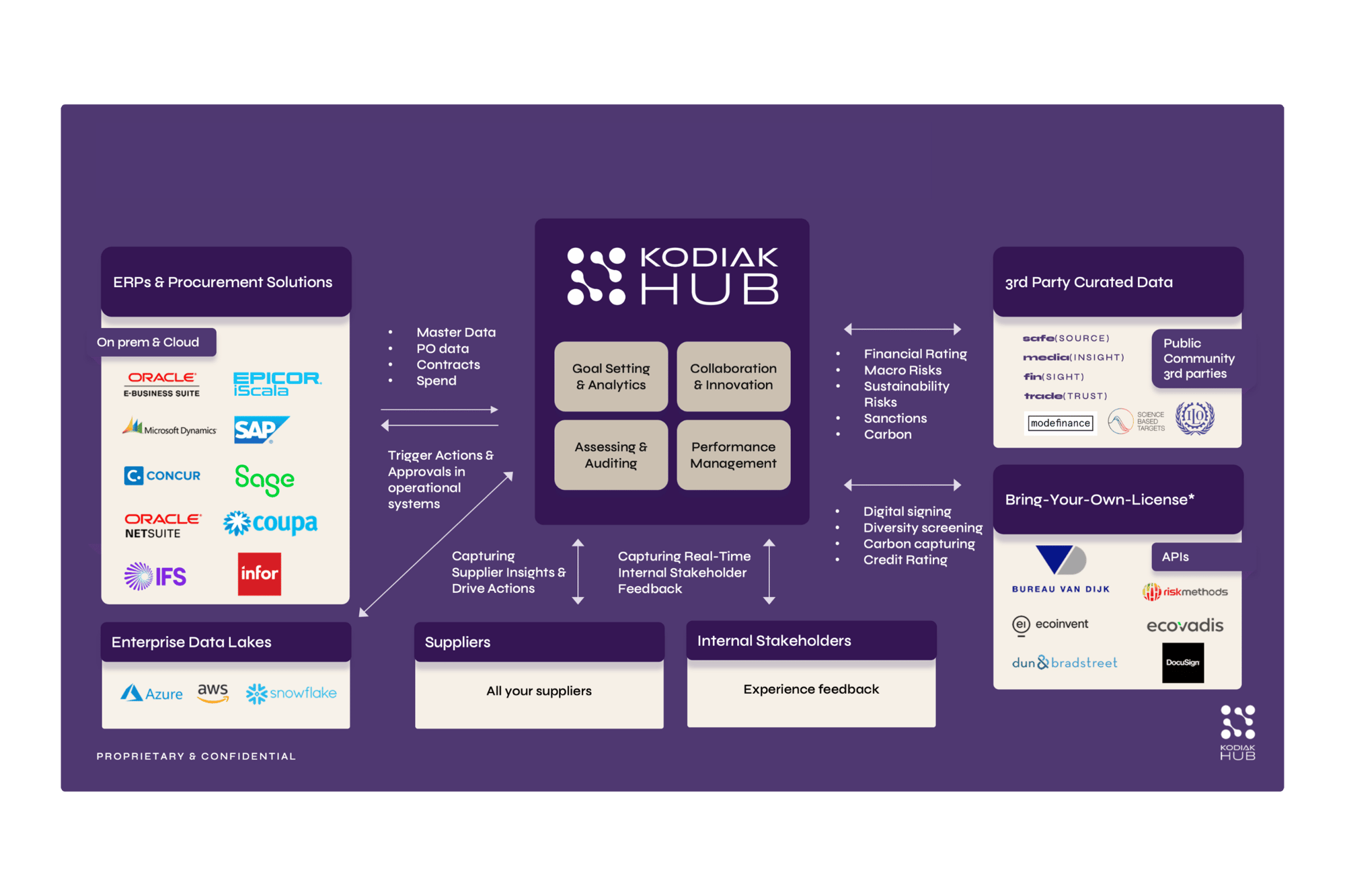
See how Kodiak Hub connects spend with supplier management 👇🏼