
.png?width=750&height=750&name=Thought%20Leadership%20(3).png)


.png?width=750&height=750&name=Webinar%20Linkedin%201x1%20(3).png)



.png?width=1200&height=1200&name=Webinar%20Linkedin%201x1%20(6).png)

.png?width=750&height=750&name=Webinar%20Linkedin%201x1%20(11).png)
.png?width=2000&name=3x2%20Images%20(4).png)

.png?width=1200&height=1200&name=Webinar%20Linkedin%201x1%20(10).png)

What is a supplier scorecard?
A supplier scorecard is a structured way to measure, compare, and improve supplier performance over time.
It gives procurement, supply chain, quality, sustainability, and finance teams one shared view of how a supplier is performing across the areas that matter most to the business. That usually includes delivery, quality, cost, compliance, risk, responsiveness, innovation, and sustainability.
A good supplier scorecard does not just answer:
"Did this supplier deliver on time?"
It helps answer:
"Is this supplier still the right partner for our business?"
That difference matters.
Many procurement teams already have some form of supplier scoring in place. It might be an Excel file, a quarterly business review template, an ERP export, or a simple traffic light system. The problem is that these scorecards often live outside the day-to-day supplier management process. They are updated manually, reviewed too late, and disconnected from the data that should drive action.
The strongest supplier scorecards turn supplier data into decisions. They show what is working, what is slipping, where risks are emerging, and which suppliers should receive more attention, more business, or a corrective action plan.
Why supplier scorecards matter
Supplier performance is no longer only about price and delivery.
Procurement teams are expected to manage cost, supply continuity, ESG expectations, third-party risk, supplier quality performance, compliance documentation, and supplier collaboration - often with lean teams and scattered data.
That is why supplier scorecards are becoming more important. They create a common language for supplier performance.
Without a scorecard, supplier management can become subjective. One stakeholder might say a supplier is "good" because they are responsive. Another might say the same supplier is "poor" because they have recurring non-conformities. Finance might care about payment terms. Quality might care about defect rates. Sustainability might care about certifications and audit data.
A supplier scorecard brings those perspectives together.
It helps teams:
- Compare suppliers in the same category
- Identify top and bottom performers
- Spot delivery, quality, or risk trends earlier
- Prioritize supplier development work
- Support QBRs with evidence
- Reduce emotional or anecdotal supplier decisions
- Align internal stakeholders around the same definition of performance
The goal is not to punish suppliers. The goal is to create visibility, consistency, and better conversations.
Supplier scorecard metrics
The best supplier scorecard metrics depend on your category, industry, and supplier relationship. A raw material supplier, logistics provider, contract manufacturer, packaging supplier, IT vendor, and professional services provider should not all be measured in exactly the same way.
Still, most strong supplier scorecards include a mix of the following metric categories.
1. Delivery performance
Delivery metrics show whether a supplier can reliably meet operational needs.
Common delivery metrics include:
- On-time delivery
- On-time in-full delivery
- Average delay in days
- Lead time accuracy
- Schedule adherence
- Expedited shipment frequency
- Backorder rate
- Missed delivery commitments
For direct materials and manufacturing environments, delivery performance is often one of the most visible parts of the supplier scorecard. If a supplier is late, the impact can quickly spread into production planning, inventory levels, customer delivery, and revenue.
But delivery metrics should not be viewed in isolation. A supplier with 98 percent on-time delivery might still be a poor fit if quality performance is weak. A supplier with occasional delays might still be strategic if they provide unique technical capability, strong innovation, or critical capacity.
2. Quality performance
Quality metrics show whether the supplier consistently delivers what was agreed.
Common quality metrics include:
- Defect rate
- Parts per million defects
- Non-conformities
- Corrective action requests
- Rejected lots
- First-pass yield
- Warranty claims
- Customer complaints linked to supplier issues
- Audit findings
- Certificate validity
Quality is one of the most important supplier scorecard categories because it connects supplier performance directly to risk. Poor supplier quality can create production delays, rework, customer dissatisfaction, regulatory exposure, and brand damage.
A useful supplier scorecard should also separate different types of quality issues. For example, a late certificate renewal is not the same as a recurring product defect. A minor documentation issue is not the same as a critical non-conformity.
3. Cost and commercial performance
Commercial metrics show whether the supplier supports the financial goals of the business.
Common cost and commercial metrics include:
- Price competitiveness
- Cost reduction contribution
- Payment term compliance
- Invoice accuracy
- Rebate or discount performance
- Total cost of ownership
- Cost variance against contract
- Freight or expedite cost impact
- Savings delivered
- Cost avoidance
This is where procurement teams should be careful. A supplier scorecard should not simply reward the lowest price. A low-cost supplier with poor delivery, weak quality, or high operational friction can be more expensive in practice.
A better approach is to score commercial performance alongside operational and risk performance. That helps teams understand the real supplier value, not just the unit price.
4. Risk and compliance
Supplier risk metrics show whether a supplier creates exposure for your business.
Common risk and compliance metrics include:
- Sanctions screening status
- Financial health
- Country risk exposure
- Cybersecurity requirements
- Insurance status
- Code of conduct acceptance
- Policy acceptance
- Contract status
- Regulatory compliance
- Data protection requirements
- Business continuity planning
- Critical dependency risk
Risk has become a core part of supplier performance management. A supplier can perform well operationally and still create unacceptable risk if they lack required documentation, operate in high-risk regions, have weak financial health, or fail to meet compliance obligations.
This is why modern supplier scorecards increasingly combine internal performance data with third-party risk data and supplier-submitted information.
5. Sustainability and ESG performance
Sustainability metrics show whether suppliers support your environmental, social, and governance goals.
Common sustainability metrics include:
- Emissions data availability
- Sustainability policy
- Human rights policy
- Labor standards
- Environmental certifications
- Responsible sourcing practices
- Supplier diversity
- Audit results
- ESG assessment score
- Corrective action progress
- Scope 3 data contribution
Sustainability scoring should be practical. Many companies start by asking whether the supplier has the required policies, certifications, and data. Over time, they can move toward measurable improvement targets, category-specific sustainability requirements, and supplier development plans.
The important thing is to avoid treating sustainability as a static checkbox. A supplier scorecard should help track progress over time.
6. Collaboration and responsiveness
Collaboration metrics show how easy and effective the supplier is to work with.
Common collaboration metrics include:
- Response time
- Issue resolution time
- QBR participation
- Corrective action closure rate
- Forecast collaboration
- Innovation contribution
- Engineering support
- Account management quality
- Escalation handling
- Stakeholder feedback
This category is often overlooked because it is harder to measure than OTD or PPM. But it matters.
A supplier that communicates early, solves problems quickly, and proactively brings improvement ideas can be more valuable than a supplier that simply meets the minimum KPI threshold.
To measure collaboration fairly, combine stakeholder feedback with objective workflow data. For example, track how quickly suppliers respond to actions, upload documents, close corrective actions, or participate in improvement initiatives.
Supplier scorecard example
Here is a simple supplier scorecard example that can be adapted for most procurement teams.
| Scorecard category | Example metrics | Weight |
|---|---|---|
| Delivery performance | On-time delivery, OTIF, lead time accuracy | 25% |
| Quality performance | Defect rate, non-conformities, corrective actions | 25% |
| Cost and commercial performance | Price competitiveness, invoice accuracy, cost savings | 15% |
| Risk and compliance | Financial health, sanctions status, required documents, contract status | 15% |
| Sustainability | ESG assessment, certifications, emissions data, audit results | 10% |
| Collaboration | Responsiveness, issue resolution, QBR participation, innovation | 10% |
Example scoring model
Use a 1-5 scale for each category:
| Score | Meaning |
|---|---|
| 5 | Excellent performance, consistently exceeds expectations |
| 4 | Good performance, minor issues only |
| 3 | Acceptable performance, improvement needed |
| 2 | Poor performance, repeated issues or elevated risk |
| 1 | Critical performance issue, escalation required |
Example supplier score calculation
If a supplier receives the following scores:
| Category | Weight | Score | Weighted result |
|---|---|---|---|
| Delivery | 25% | 4 | 1.00 |
| Quality | 25% | 3 | 0.75 |
| Cost | 15% | 4 | 0.60 |
| Risk and compliance | 15% | 2 | 0.30 |
| Sustainability | 10% | 3 | 0.30 |
| Collaboration | 10% | 5 | 0.50 |
| Total | 100% | 3.45 / 5 |
In this example, the supplier is performing reasonably well overall. But the low risk and compliance score should trigger action. The supplier might be delivering on time and collaborating well, but missing required documents, showing financial risk, or failing to meet policy requirements.
That is the point of a supplier scorecard: it shows the full picture.
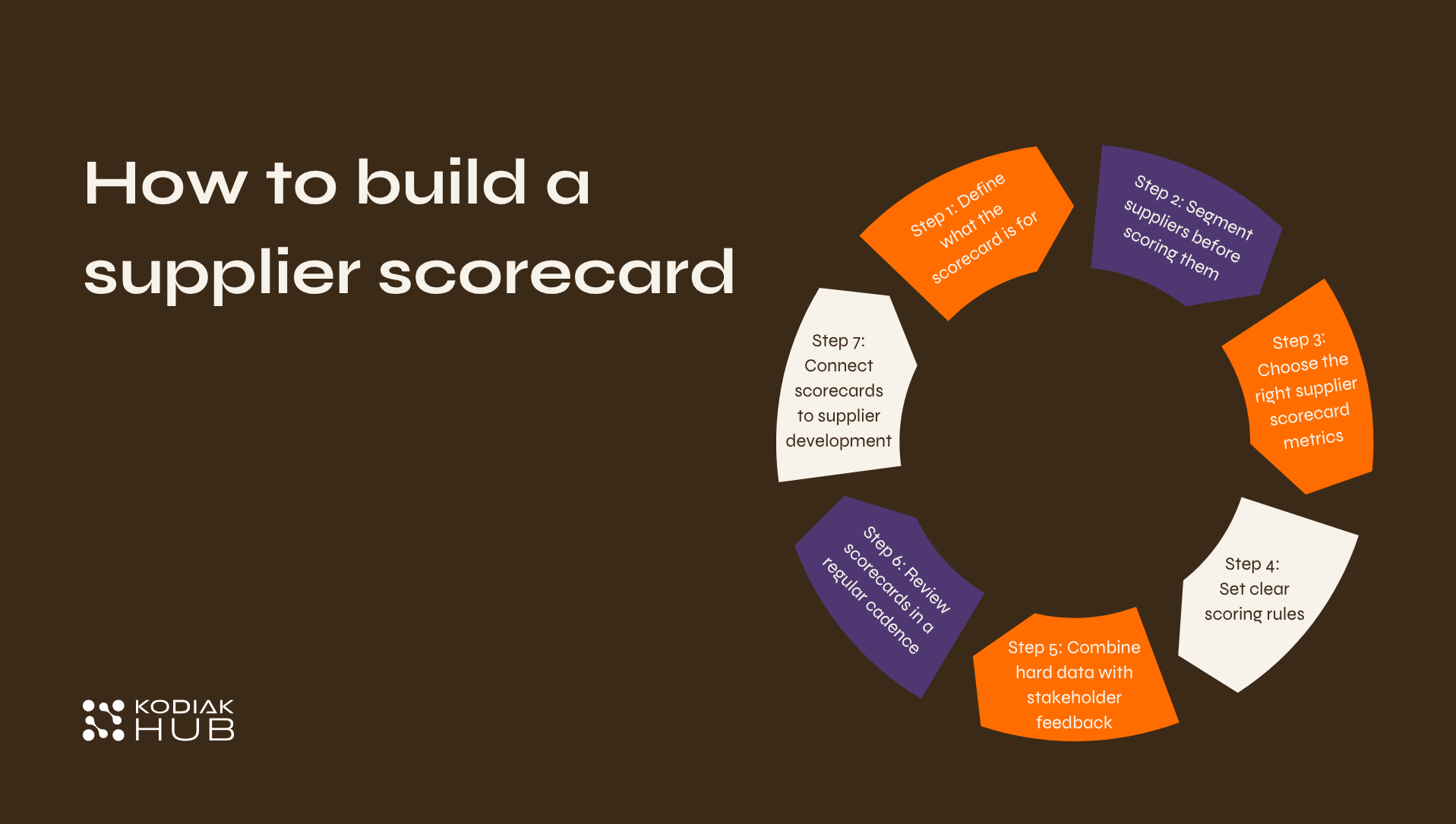
How to build a supplier scorecard
A supplier scorecard should be simple enough to use, but complete enough to drive the right decisions.
Here is a practical step-by-step approach.
Step 1: Define what the scorecard is for
Start with the decision the scorecard should support.
Are you trying to:
- Improve supplier quality?
- Reduce delivery disruptions?
- Identify supplier risk?
- Prepare better QBRs?
- Support supplier segmentation?
- Decide which suppliers should receive more business?
- Track supplier development plans?
- Standardize supplier reviews across categories?
A supplier scorecard that tries to measure everything from day one will become too complex. Start with the decisions that matter most.
Step 2: Segment suppliers before scoring them
Not every supplier needs the same scorecard.
A strategic supplier should be scored differently from a low-spend, low-risk supplier. A direct material supplier should be scored differently from a software provider. A supplier with access to sensitive data should be scored differently from a supplier providing office supplies.
Useful segmentation criteria include:
- Spend
- Criticality
- Category
- Region
- Substitution difficulty
- Quality impact
- Customer impact
- Regulatory exposure
- Data access
- ESG relevance
Segmentation helps you avoid over-measuring suppliers where the risk is low and under-measuring suppliers where the risk is high.
Step 3: Choose the right supplier scorecard metrics
Select metrics that are measurable, relevant, and actionable.
A good metric should answer three questions:
- Can we get the data reliably?
- Does the metric tell us something important?
- Can we act on the result?
For example, "supplier relationship quality" might be too vague. "Average response time to corrective actions" is more actionable.
Step 4: Set clear scoring rules
A supplier scorecard only works if people understand how scores are calculated.
For each metric, define what good and bad looks like.
For example:
| On-time delivery | Score |
|---|---|
| 98-100% | 5 |
| 95-97.9% | 4 |
| 90-94.9% | 3 |
| 80-89.9% | 2 |
| Below 80% | 1 |
For quality:
| Defect rate | Score |
|---|---|
| 0 critical defects and low minor defects | 5 |
| Minor defects, no repeated issue | 4 |
| Some recurring issues | 3 |
| Frequent non-conformities | 2 |
| Critical or unresolved quality issues | 1 |
Clear thresholds make the scorecard more objective and easier to defend.
Step 5: Combine hard data with stakeholder feedback
Some supplier performance data comes from systems. Some comes from people.
Hard data might include:
- ERP delivery data
- PPM
- Claims
- Spend
- Invoice accuracy
- Contract status
- Audit findings
- Certificate expiry dates
Stakeholder feedback might include:
- Responsiveness
- Technical support
- Commercial flexibility
- Innovation contribution
- Ease of collaboration
- Problem-solving behavior
The best supplier scorecards use both. System data gives objectivity. Human feedback captures the supplier experience that systems often miss.
Step 6: Review scorecards in a regular cadence
A supplier scorecard should not be updated once a year and forgotten.
Use different cadences depending on supplier importance:
- Strategic suppliers: monthly or quarterly
- Critical suppliers: quarterly
- Approved suppliers: twice per year
- Low-risk suppliers: annually or by exception
The review should focus on trends and actions, not just scores.
Ask:
- What changed since the last review?
- Which metric is improving?
- Which metric is declining?
- What is the root cause?
- What action is needed?
- Who owns the follow-up?
- When will we review progress?
Step 7: Connect scorecards to supplier development
A scorecard is only useful if it leads to action.
When performance drops, create a corrective action plan. When a supplier improves, recognize it. When a supplier consistently performs well, consider expanding the relationship. When a supplier stays below threshold, consider exit planning or dual sourcing.
Scorecards should support supplier development, not just supplier evaluation.
Check out our downloadable supplier scorecard template. No email or anything required.
Common supplier scorecard mistakes
Mistake 1: Measuring too many things
If everything is important, nothing is important.
A scorecard with 80 metrics will not create better supplier management. It will create administrative work. Start with the 8-12 metrics that most clearly connect to business outcomes.
Mistake 2: Using the same scorecard for every supplier
A one-size-fits-all scorecard creates false comparisons.
A packaging supplier, software provider, logistics partner, and contract manufacturer do not create value or risk in the same way. Use category-specific weightings.
Mistake 3: Relying only on lagging indicators
Delivery failures, defects, and complaints are important, but they often show problems after they have already affected the business.
Add leading indicators, such as:
- Expiring certificates
- Slow corrective action response
- Declining financial health
- Missing audit data
- Increased lead time variability
- Repeated late document submissions
Leading indicators help procurement act earlier.
Mistake 4: Keeping scorecards in Excel forever
Excel can be a good starting point. But as the supplier base grows, spreadsheet-based scorecards become difficult to maintain.
Common problems include:
- Manual updates
- Version control issues
- No audit trail
- Limited automation
- Disconnected ERP data
- Difficult supplier comparison
- No automatic alerts
- No direct link to corrective actions
At some point, the scorecard becomes less about performance management and more about spreadsheet maintenance.
Mistake 5: Not involving suppliers
Suppliers should understand how they are measured.
If the scorecard is used in QBRs, supplier development, or corrective action plans, make the scoring logic clear. Show suppliers where they are performing well, where improvement is needed, and how they can influence the result.
The supplier scorecard should become the basis for a better conversation.
Supplier scorecards and supplier relationship management
A supplier scorecard is one part of supplier relationship management. It should connect to the broader supplier lifecycle.
That means the scorecard should not sit separately from:
- Supplier onboarding
- Supplier qualification
- Risk assessment
- Contract management
- Document management
- Compliance tracking
- Performance evaluation
- Audits
- Corrective actions
- QBRs
- Supplier development
When these processes are disconnected, supplier management becomes reactive. Procurement teams spend too much time finding data and not enough time acting on it.
A more mature approach is to make the supplier scorecard the central view of the supplier relationship.
This gives teams one place to see:
- Who the supplier is
- What category they belong to
- Which contracts and documents are linked to them
- Which risks are open
- Which metrics are improving or declining
- Which actions are overdue
- Which stakeholders are involved
- Which suppliers need attention now
That is where supplier scorecards become powerful. Not as a static report, but as an operational tool.
Learn more how Kodiak Hub's supplier relationship management software connects your supplier scorecards to your overall SRM.
From static scorecard to living supplier intelligence
The next generation of supplier scorecards will be more connected, more automated, and more predictive.
Instead of manually updating a quarterly spreadsheet, procurement teams will increasingly expect supplier scorecards to pull information from ERP systems, third-party risk data, supplier assessments, audits, contract repositories, and stakeholder feedback.
That shift changes the role of the scorecard.
Old supplier scorecards answer:
"What happened last quarter?"
Modern supplier scorecards answer:
"What is happening now, why does it matter, and what should we do next?"
For example:
- If a supplier’s delivery score drops below threshold, create a corrective action.
- If a certificate is about to expire, notify the supplier.
- If a supplier’s risk profile changes, alert the category manager.
- If a supplier becomes a top performer in a category, consider shifting more spend.
- If a supplier has repeated non-conformities, trigger a supplier development workflow.
This is the difference between supplier reporting and supplier management.
How Kodiak Hub supports supplier scorecards
Kodiak Hub helps procurement, quality, sustainability, and supply chain teams turn supplier scorecards into a connected supplier management process.
Instead of managing scorecards in spreadsheets, teams can bring supplier data, documentation, risk insights, assessments, performance metrics, and collaboration into one supplier view.
With Kodiak Hub, teams can:
- Create supplier scorecards across categories and regions
- Combine ERP performance data with supplier assessments and stakeholder feedback
- Track delivery, quality, commercial, risk, compliance, and sustainability metrics
- Monitor certificates, contracts, and documentation
- Trigger actions when supplier performance drops below threshold
- Compare suppliers by category, rating, risk, or performance
- Support QBRs with live supplier data
- Build a more consistent supplier evaluation process
The result is a supplier scorecard that does more than display performance. It helps teams decide where to focus, which suppliers to develop, which risks to act on, and which relationships deserve more investment.
Check out Kodiak Hub's supplier scorecard software here.
Final thoughts: a supplier scorecard should drive action
A supplier scorecard is not just a procurement report.
It is a decision-making tool.
Used well, it helps teams move from fragmented supplier data to a shared understanding of supplier performance. It helps procurement stop relying on scattered spreadsheets, outdated reports, and subjective feedback. And it gives suppliers a clearer view of what good performance actually means.
The best supplier scorecards are simple, fair, measurable, and connected to action.
They show where suppliers stand today.
They reveal where performance is trending.
And most importantly, they help procurement teams decide what to do next.
Don't miss to check out our vendor performance management software.