













Most procurement teams measure supplier performance.
Fewer can confidently say they are improving it.
There is an important difference.
A scorecard can tell you what happened. An on-time delivery percentage can tell you whether a supplier met its target. A quality KPI can tell you whether defects are increasing.
But none of those things, on their own, make a supplier better.
Supplier performance improvement starts when measurement becomes action - and when procurement can connect what it knows about a supplier to what happens next.
That matters particularly in direct materials.
Deloitte's 2025 Global Chief Procurement Officer Survey found that 64% of procurement leaders prioritized greater supply chain visibility as a risk mitigation strategy, while 61% focused on improving supplier information sharing and collaboration.
But visibility is only useful if teams can do something with it.
In direct materials, supplier performance becomes your performance
In indirect spend, if your office supplies or IT services provider underperforms, it is an annoyance. You switch, and life goes on.
In direct materials, the supplier is effectively part of your product.
Their component goes into what you sell. If it is late, your line stops. If it is wrong, your customer gets a defective product.
Switching is also much harder. A new supplier for a critical part can mean months of qualification, testing, and approvals.
That changes what "performance" means.
In indirect procurement, performance might be predominantly about price and service levels. In direct materials, it becomes quality, delivery, flexibility, capability, and risk - all tied to specific parts and specific products.
This is also why supplier management cannot be disconnected from operational performance. Research published in the International Journal of Production Economics has examined supplier management across outcomes including quality, delivery, flexibility and cost rather than treating supplier performance as a single procurement metric.(ScienceDirect)
Quality should be at the center of supplier performance
Poor quality is one of the most expensive things a supplier can deliver, and price rarely shows the true cost.
A part that is 5% cheaper but fails inspection, causes rework, or triggers a claim is not cheaper.
There is an environmental cost too. Defective products mean scrapping, reworking, and doing things twice.
And in regulated industries, a quality escape can turn into a recall or a brand problem very quickly.
Quality also tells you something about the supplier as a whole: how they run their processes and how they respond when something goes wrong. It is often one of the earliest signs of deeper trouble.
We see what happens when teams put quality at the center.
Elfa, one of our customers, raised supplier quality from 82% to 98%, while claims fell by 58%.
The point is not that price does not matter.
It is that suppliers need to be judged on total cost - and supplier quality is a major driver of it.
What does a high-performing supplier actually look like?
Quality and delivery are the foundation.
But they are also largely lagging indicators.
The best supplier relationships should also be measured on things like responsiveness: how quickly does the supplier answer? How do they handle a problem?
Flexibility: can they ramp production up or down when demand changes?
Collaboration and innovation: do they bring ideas, or simply fill orders?
Then there is sustainability, compliance, and financial resilience.
In a volatile environment, a supplier that has designed its operation to adapt to changing circumstances is incredibly valuable.
There are also two things that organizations frequently miss.
The first is the voice of their own organization.
Quality engineers, plant managers, and buyers all experience a supplier differently. That experience is valuable data.
The second is segmentation.
Not every supplier should be measured the same way.
A strategic partner and a commodity supplier need different KPIs and different levels of engagement.
Segmenting your suppliers first, and then deciding what "good" looks like for each segment, is what makes measurement meaningful.

Stop measuring compliance as a yes-or-no question
There is another shift procurement teams need to make.
Stop asking:
"Do they have the certificate?"
Start asking:
"Do they have a management system and a way of operating that is designed for change, speed, and agility?"
Compliance often asks a yes-or-no question.
Do they have the policy? The certificate? The signed code of conduct?
Performance asks how much and how fast.
That is a big shift.
For flexibility, it means measuring how a supplier actually responded the last time demand spiked - not whether they said they could respond.
For innovation, it means tracking ideas proposed, joint development projects, and cost improvements delivered.
For sustainability, it means looking at the trajectory: emissions coming down, findings being closed, and practices improving year on year, rather than simply having a certificate on file.
When you frame these things as outcomes, you can set goals together with the supplier, review them regularly, and reward the suppliers that deliver.
That is how compliance turns into impact.
Measuring supplier performance is not improving supplier performance
This is one of the biggest gaps we see.
Teams build beautiful scorecards.
And then nothing happens.
The scorecard becomes the end product instead of the starting point.
Moving from supplier performance measurement to supplier performance improvement takes three things.
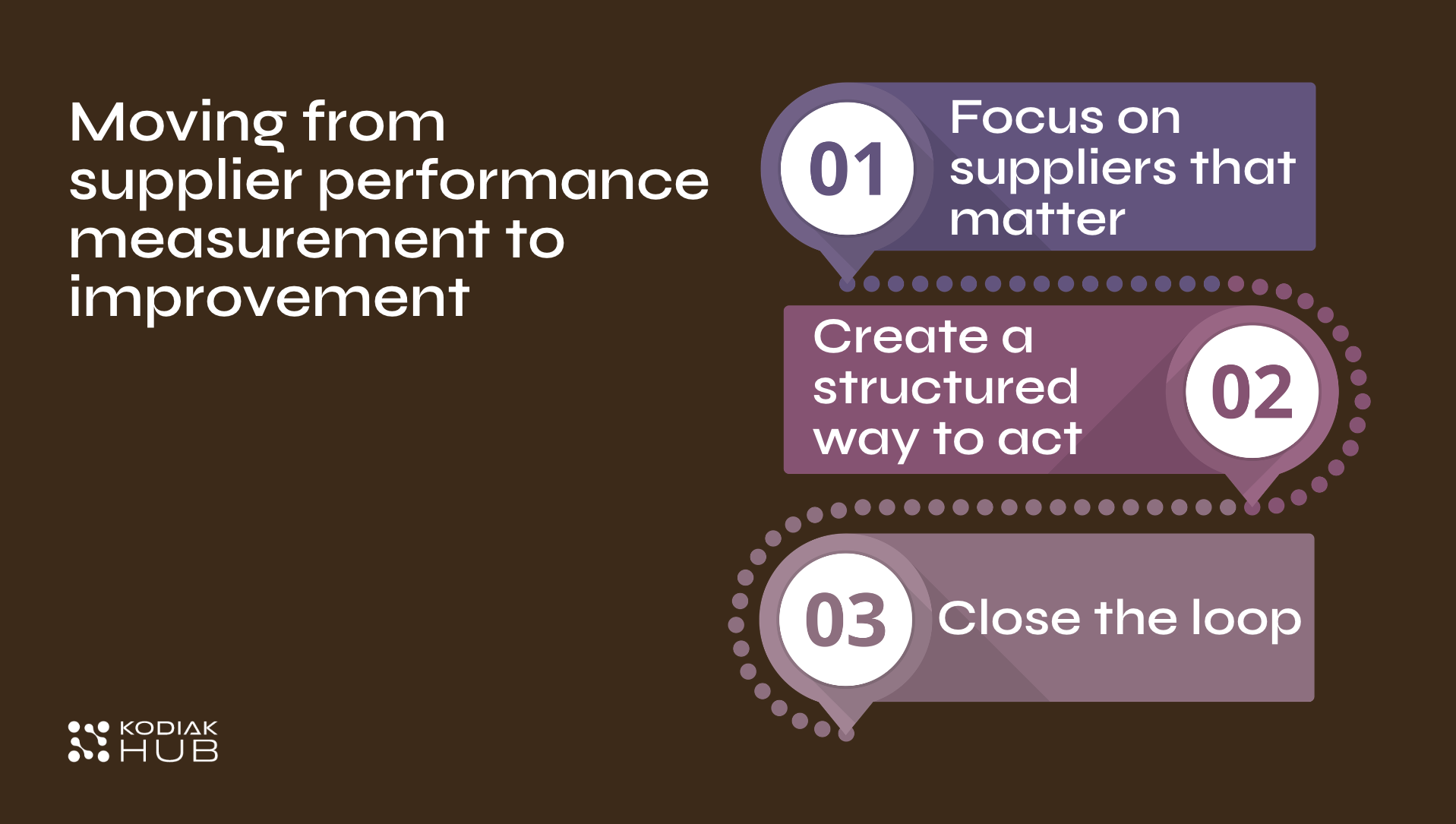
1. Focus on the suppliers that matter
You cannot develop every supplier.
Choose the suppliers that matter most and the relationships where there is genuine potential to improve performance.
2. Create a structured way to act
Corrective actions, 8D processes, and joint improvement plans need clear owners and deadlines - on the supplier side too.
A red score is not an action.
Someone needs to own what happens next.
3. Close the loop
Go back after 90 days and ask whether the problem is actually gone.
We think about this as Plan, Do, Check, Act.
Most organizations are pretty good at Check.
The value is in Act - and in making sure Act feeds back into the next Plan.
That is also where technology can help most, because a lot of supplier improvement work dies in email threads and follow-ups.
And this is why talking about a "system of execution" is not enough.
Execution needs to create results and impact. Execution is just another means.
Learn more about this in our supplier scorecard playbook: from tracking to driving performance.
Better supplier performance changes more than the scorecard
The operational effects are very direct.
Better supplier quality means fewer line stoppages, less rework, fewer claims, and less scrap.
Better delivery reliability means you can hold less safety stock, freeing up working capital.
But the biggest effect is often on your people.
When suppliers perform, your teams stop firefighting and can spend more of their time on improvement and innovation instead.
It makes the business more resilient too.
A supplier base you understand and trust is one you can adapt quickly.
When disruption hits, you know which suppliers can flex, who is already qualified as an alternative, and where your exposure sits.
The winners do not avoid disruption.
Nobody can.
They adjust first.
Most companies are rich in supplier data and poor in supplier signals
Procurement does not necessarily have a data problem.
It has a signal problem.
There are a few missing signals we see again and again.
The first is what your own people know.
Quality engineers, plant staff, and buyers all have a view of a supplier, but much of that knowledge lives in people's heads or in emails.
The second is behavior.
How quickly does a supplier respond to requests? Are they starting to submit documents late? Are survey responses getting thinner?
Those small changes can be early warning signs.
The third is what happens at item level.
A supplier can look perfectly healthy on average while one specific part repeatedly fails.
If you only look at an overall supplier score, you miss it.
And finally, there is the context behind decisions.
Why did we approve this supplier?
Why did we accept that risk?
Most companies do not capture that context, which means they cannot learn from it later.
Turn supplier site visits into data you can actually use
Site visits are one of the richest sources of supplier insight - and one of the most wasted.
Someone walks the shop floor and notices the housekeeping, the morale, or how the supplier handles nonconforming parts.
Then those observations end up in a PowerPoint or someone's personal notebook.
Instead, capture the information while you are there.
Use a phone or tablet. Capture a few scored criteria, free-text observations, and photos.
Then link those observations to the supplier record so they sit alongside quality data, delivery data, and risk data.
This is an area where AI genuinely helps.
People write and speak naturally. AI can help turn notes, photos, and documents into structured findings, flag something that requires corrective action, and compare observations across visits and suppliers.
Suddenly, the supplier audit is not an anecdote.
It is a data point you can act on.
Moving from retrospective reporting to predictive supplier management
If you want supplier data to become predictive, rather than simply another way of explaining what went wrong last month, three things need to happen.
First, consistency.
If every site and every buyer measures suppliers differently, you cannot compare anything. You need a shared definition of what good looks like and a common rating framework.
Second, history.
Prediction needs time series. You need to collect the same signals, in the same way, over months and years.
Third - and this is the one most people miss - you need to connect the data to outcomes.
Did the supplier we rated as high risk actually fail?
Did the corrective action actually stop the problem?
When you link the signals to what happened next, you can start to identify patterns.
And then you can start to predict.
That is also why every single data point counts.
The work your team does today is building the intelligence you will rely on tomorrow.
Language models understand context. Machine learning predicts outcomes.
AI in procurement is often discussed almost entirely through the lens of large language models.
But there is an important distinction.
Language models are brilliant at understanding text and context: reading documents, summarizing an audit report, or answering a question in plain language.
Supplier performance, however, is also made up of a lot of numbers: quality rates, delivery times, ratings over time, and risk scores.
That is where machine learning becomes valuable.
It can identify patterns across thousands of suppliers and years of history that no person could realistically spot.
That might mean identifying the combination of signals that tends to appear a few months before a supplier's delivery performance drops.
Or predicting how a new supplier is likely to perform from a handful of basic facts such as country, size, industry, and financial health before you have even run an assessment.
Instead of "we'll know in three weeks," you have a signal today.
The real power comes from combining the two.
Machine learning tells you what is likely to happen. The language model helps you understand why and what to do about it.
Supplier performance improvement ultimately means acting earlier
A more signal-driven approach changes the whole rhythm of supplier management.
Today, most teams discover supplier problems after they happen: a late shipment, a failed inspection, a claim.
With better signals, you can see the drift before it becomes a failure and act while it is still cheap to fix.
It also changes where procurement spends its time.
Instead of reviewing every supplier in exactly the same way once a year, you focus attention on the suppliers the signals point to.
Routine coordination can increasingly be handled by agents, under your rules and with your approval.
And that changes procurement's role.
When you can say:
"We saw this coming, we acted, and here is what it saved."
Procurement stops being seen purely as a cost center and starts being seen as the function that keeps the business running and improving.
A simple supplier performance test
Here is something any procurement team can do next week.
Take your 20 most critical direct-material suppliers and ask three questions:
- If this supplier failed tomorrow, which of our products would be affected?
- Do we already have a qualified alternative?
- How is this supplier actually performing on quality at the part level - not just on average?
If you can answer all three within a day, you are in good shape.
If you cannot, you have just found your starting point.
And one bonus step: ask your quality and plant colleagues what they know about those suppliers that is not written down anywhere.
You might be surprised how many signals you are missing.
Turn supplier performance into action
Supplier performance improvement is not about building a bigger scorecard.
It is about connecting what you know to what you do next.
Measure the things that actually affect the product and the business. Capture the signals that normally disappear into inboxes, notebooks, and people's heads. Give findings owners, actions, and deadlines. Then go back and check whether those actions worked.
That is how supplier performance stops being a quarterly reporting exercise and becomes a continuous improvement system.
And eventually, it is how hindsight becomes foresight.
See how Kodiak Hub's supplier performance management software helps you capture signals and trigger actions for improvement.